Your chauffeur in Sélestat
Via Entzheim, EuroAirport or the train
From Entzheim, your chauffeur takes the M35 and then the A35 towards Colmar, entering Sélestat on the Route de Strasbourg. Your flight number goes into the booking; the meeting point in the arrivals hall is one your chauffeur confirms with you. By rail, the airport station is served by line 07, Strasbourg – Obernai – Sélestat; otherwise the shuttle reaches Strasbourg station in 8 minutes, and from there the town quotes a 20-minute train ride to Sélestat.
From EuroAirport Basel-Mulhouse, no published route ends in Sélestat: the nearest stops at Colmar, 62 km from the airport, and Sélestat lies further north. The pickup is still booked the same way, with the airport as the start and your address as the destination; before you land, your chauffeur confirms where they will wait, on the French side. By public transport, bus 11 leaves the French sector every 15 to 30 minutes between 5 am and midnight for Saint-Louis station (€3 by text message), where a direct train to Sélestat leaves every 30 minutes.
Sélestat station is on the Strasbourg – Basel regional line: according to the tourist office, 27 return trips a day link it with Strasbourg, plus one daily TGV return trip to Paris-Est. Regional lines 20 and 23 also start here, to Sainte-Marie-aux-Mines and to Ribeauvillé, the latter running on to Riquewihr on Sundays and public holidays. Give your train number when you book, and your chauffeur will tell you where to meet. In Strasbourg, they collect you at the address of your choice, 52 km from Sélestat by road.
The Humanist Library and the old town
Sélestat’s parish library began in 1452 with a gift from Johannes von Westhuss, rector of the parish church. In July 1547 the humanist Beatus Rhenanus, a former pupil of the town’s Latin school, bequeathed his own library to it: 423 volumes and 255 autograph letters. His library has been on UNESCO’s Memory of the World Register since 2011, and the collections now hold some 460 manuscripts, 550 incunabula and nearly 2,500 books printed in the 16th century.
The collections have been housed since 1889 in the former corn exchange. From 2014, four years of work led by the architect Rudy Ricciotti kept the neo-Romanesque façade and added a pink sandstone extension and basement stores. The library, on Place du Docteur Maurice Kubler, opens Tuesday to Sunday: 10 am to 12.30 pm and 1.30 pm to 6 pm from May to September and in December, and 1.30 pm to 5.30 pm from February to April and in October and November. It is closed on Mondays, throughout January, on 1 May and on 25 and 26 December; admission is €7.50, free for visitors up to 25.
Around it, the old town lines up the Romanesque church of Sainte-Foy, the Gothic church of Saint-Georges and the Porte de Strasbourg, a remnant of Vauban’s fortifications, among Renaissance and 18th-century houses. For drivers, parking in the centre is charged from 8.30 am to 12 noon and from 2 pm to 6 pm, Monday to Saturday; with a chauffeur, you step out as close as possible to your hotel or the library, at a point they confirm, with no space to hunt for.
Haut-Kœnigsbourg and the Kintzheim parks
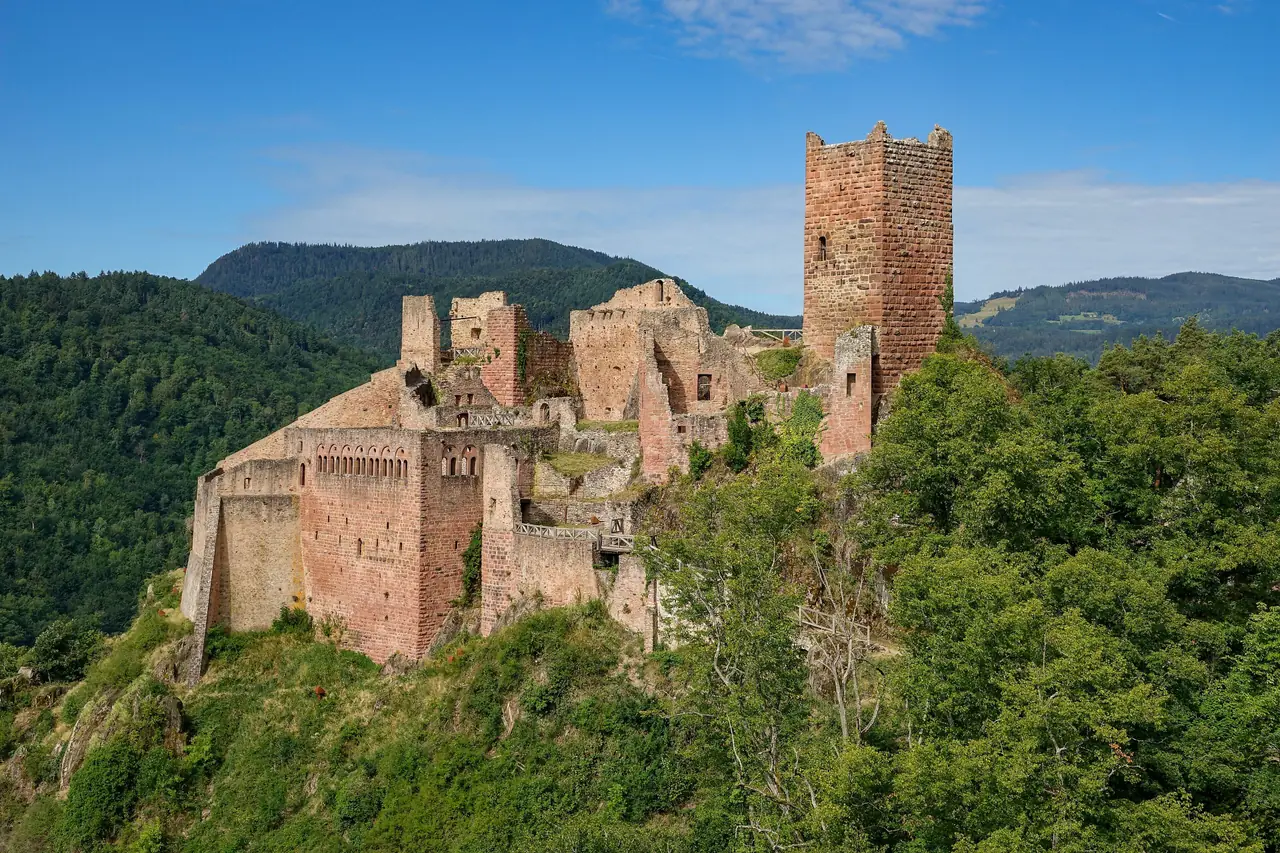
Standing 757 m up, 12 km west of Sélestat, Haut-Kœnigsbourg is first recorded in 1147. The Tierstein family took it over in 1479 and enlarged it; besieged, looted and burnt in 1633, during the Thirty Years’ War, it was then abandoned for two centuries. In 1899 the town of Sélestat gave the ruins to Emperor Wilhelm II, who had them restored from 1900 to 1908 by the architect Bodo Ebhardt. Owned since 1 January 2021 by the Collectivité européenne d’Alsace, the castle welcomed 596,708 visitors in 2023.
The road up goes via Kintzheim or Saint-Hippolyte, from exits 17 and 18 of the A35. Around the castle, a free car park with 150 spaces has a passenger drop-off area, and a 300 m earth path climbs gently to the entrance. Inside there are about 300 steps: the visit is not accessible by wheelchair, and pushchairs are not allowed. In November and December the castle opens from 9.30 am to 12 noon and from 1 pm to 5 pm (from 10.30 am on Mondays); it closes on 25 and 26 December and on 1 January, and last entry is one hour before closing.
Without a car, line 500, the Haut-Kœnigsbourg shuttle, leaves Sélestat station from March to December on a timetable set each year; its €3 single ticket comes with a reduced admission price, and it also serves Cigoland, the eagle park (Volerie des Aigles) and the Montagne des Singes. With a chauffeur on call, you can string together the castle, a park and a wine village with no bus times to watch: it is booked for 2, 4, 6 or 8 hours, includes 10 km per hour with at least 20 km, and each kilometre beyond that is charged. For the vineyards, the catalogue also offers the “Wine Route”, “Ribeauvillé” and “Riquewihr” excursions, likewise counted from Strasbourg.
Dahlias in August, fir trees in December
Since 1929, the Corso Fleuri has paraded floats decked with dahlias through the town in August, by day and then by night, in front of tens of thousands of visitors. The 2026 edition took place on Saturday 8 August; the 2027 date has not yet been announced. On parade night, book your ride back in advance, for the time you want to leave.
For Advent 2026, from 20 November to 27 December, the Christmas markets fill Place d’Armes, Place de la Victoire and Place du Docteur Maurice Kubler, at the foot of the Humanist Library. The stalls open from 11 am to 7 pm Sunday to Thursday and from 11 am to 8 pm on Fridays and Saturdays, until 4 pm on 24 December, and are closed on the 25th. On Saturdays and Sundays from 21 November to 27 December, the town centre becomes pedestrian-only from 1 pm to 8 pm.
Sélestat takes its fir trees seriously: the town’s 1521 account book, kept in the municipal archives, records a payment of 4 shillings on 21 December to the forest wardens who guarded the communal forest on St Thomas’s Day, when fir trees were traditionally cut. The exhibition “1521, the Christmas tree tradition” is free at the Humanist Library from 21 November to 23 December and from 27 to 30 December 2026.
Highlights and seasonality
Periods such as parades and local festivals and Christmas market may affect access and traffic. Sharing your plans in advance helps us suggest a realistic margin without presenting journey times as guaranteed.